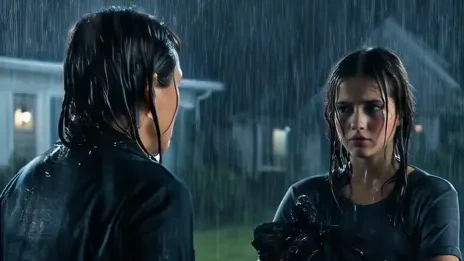

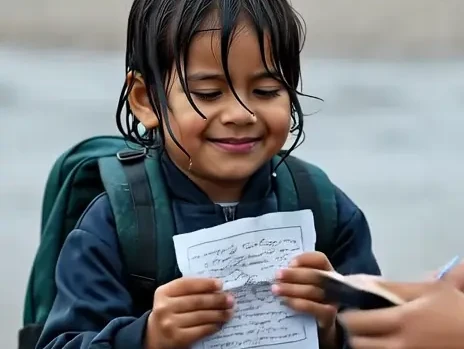
Rain slid down the bus windows in thick streaks. Emma crouched on the cracked concrete by the playground, knees tucked to her chest, clutching a folded piece of paper with trembling fingers. Her small backpack was soaked, shoes caked in mud. Every adult who had glanced at her so far had frowned, muttered something about school or manners, and walked away. They couldn’t read it, and they didn’t try.
The letter was a mess of jagged lines and loops, letters crammed together or stretched out, some upside down. It didn’t look like English, though Emma insisted it was. Her mouth had been told too many times that her handwriting made no sense. She had watched grown-ups sigh and push her away.
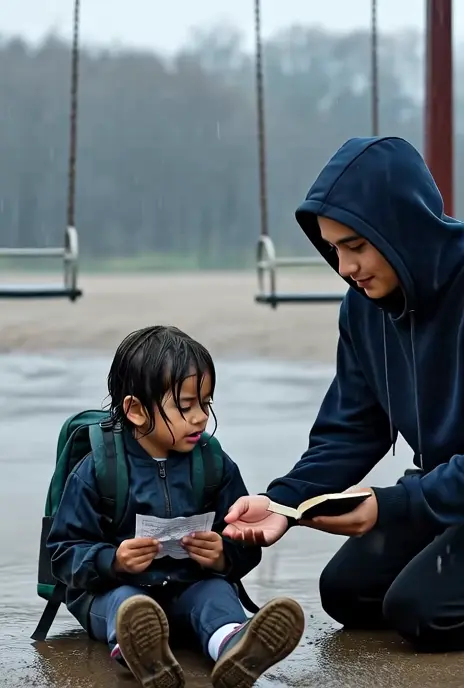
From the far end of the park came the crunch of boots over wet leaves. A man was jogging slowly, hoodie soaked, earbuds dangling. He slowed when he saw Emma sitting in the rain. He didn’t glance at the letter right away. He just crouched nearby, leaving a small space, and muttered, Are you okay?
Emma didn’t answer. She hugged the paper closer. His voice didn’t demand an answer. That’s what made her look up.
My name is Emma, she said quietly. She twisted the paper in her hands, the corners wet and curling.
I know, he said softly, nodding like he already did. He pulled off an earbud and reached for his pocket. He fished out a notebook and a pen, set it on the damp ground. Want me to see it?
Emma’s eyes widened. Adults never wanted to see it. She handed it over like a fragile bird. He stared at the letter, brow furrowed, lips moving slightly as he traced the loops with a finger. He didn’t rush. He didn’t laugh. He didn’t look at her like she was broken.
Then he smiled. Not a wide grin, just a gentle, slow smile, and wrote something in the notebook. Emma leaned forward, squinting at the neat words. They matched her own, letter for letter, except perfect and readable.
Your words are brave, he wrote. I can read them.
Her lips trembled. Nobody had ever said that. Not teachers, not her parents. Just you.
The rain eased. The sound of the city outside the park seemed farther away. Emma told him everything in stutters and hand gestures, pointing at drawings she had made along the margins, the little stories she had hidden in loops. He didn’t interrupt. He just nodded, asked questions, and made tiny scribbles in his notebook, echoing her lines, as if translating her language into a form the world could understand.
By the time the clouds thinned, Emma’s hands were dry, stiff from holding the paper so long. The man handed back her letter carefully, like it was made of glass. He smiled again.
You have stories to tell. Don’t let anyone stop you.
Emma tucked the letter back into her backpack, but she didn’t close it all the way. She watched him jog away slowly, each step leaving tiny splashes on the wet path, and for the first time in a long time, she didn’t feel invisible.
Over the next weeks, she returned to the park. Each time he came by, he’d wait, quietly, never rushing, never pressing. They made a strange kind of routine, exchanging notebooks and letters, her words becoming clearer, his translating them without losing the chaos that made them hers.
Her parents noticed she talked more, laughed more, though they still didn’t understand the letters. Teachers frowned less when she brought little folded notes to class. Some kids tried to peek, but she only smiled and shook her head.
Months later, Emma left a letter on a park bench, folded neatly, addressed to anyone who could read it. She waited from a distance, hoping someone would. A woman came, took the letter, read it slowly, her eyes widening. Emma hid behind a tree and smiled, the thrill of being understood spreading warm and bright through her chest.
The man never needed recognition. He simply nodded from afar. His quiet faith had given her courage, the bridge between a world that ignored her and the one she could finally touch.
One afternoon, the rain returned, soft and misting, and Emma sat at the edge of the park with her backpack open. She wrote another letter. She didn’t cry. She didn’t hide. She wrote loud, wild, impossible letters, just as she always had, knowing now someone would read them, and maybe, just maybe, understand everything she had been trying to say.