
The morning sun slanted through the blinds of the apartment, painting thin lines across the polished wooden floor. Michael sat at the breakfast table, squinting at the orange juice his wife had poured for him. He blinked twice, rubbed his eyes, and set the glass down.
“Everything okay, love?” Sarah asked from the kitchen doorway. Her hair was tucked neatly behind her ears, and her eyes were too sharp, too focused. Michael forced a smile.
“Yeah, just a little tired.”
She nodded and disappeared back into the kitchen. Michael lifted the glass again and sniffed it. It smelled faintly off, like something metallic. He frowned and set it down.
He had been noticing strange things for weeks. Shadows flickering in the corners of his vision, walls that seemed to sway when he turned his head, colors dulling in the morning light. The doctors said it was a rare condition, but no one could pinpoint exactly what was wrong.
Michael leaned back in his chair and rubbed his temples. The room felt colder than usual. The clock ticked loudly in the silence. He wanted to call his secretary, call someone, but the phone felt heavy in his hand.
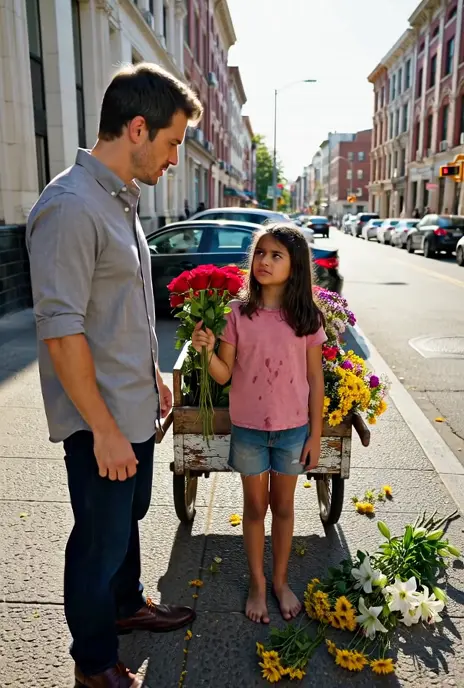
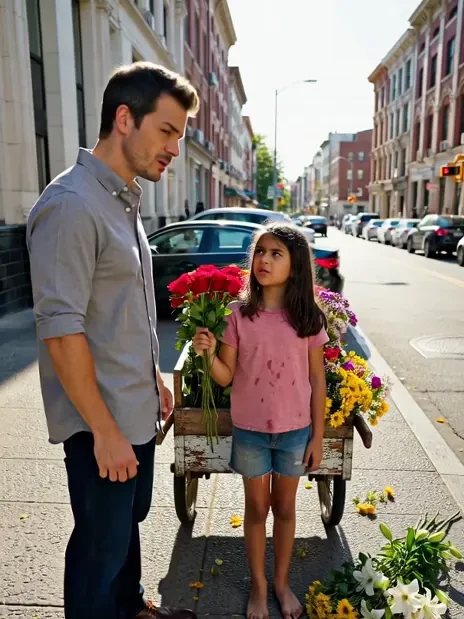
Outside the apartment, the city was waking up. Cars honked, the air smelled of fresh bread from a nearby bakery, and a street girl sold flowers from a worn cart. She was maybe twelve or thirteen, with dark hair plastered to her forehead from sweat. She noticed Michael staring out the window and waved.
“Hey mister,” she called, her voice clear over the traffic noise. “You don’t lose your sight. Your wife mixes something in your food.”
Michael laughed at first, but it came out hollow. He shook his head and turned back to his breakfast. The words lingered in the air, stubborn and sharp.
Later that day, he tried to ignore the thought. He had a meeting at his office downtown, one of those glass towers where the sunlight bounced off every surface and made him squint despite the artificial lighting.

“Mr. Thompson, your vision looks worse today,” said his assistant, Jenna, a young woman with a clipboard and a no-nonsense expression. “Are you feeling okay?”
“I’m fine,” he said, though he wasn’t. He ran a hand over his eyes and tried to focus on the spreadsheet in front of him. Numbers blurred into each other, and he squinted until he thought he could see them.
By mid-afternoon, Michael’s head throbbed. The world seemed to tilt when he walked down the hallway. He found himself leaning against the wall, breathing heavily. Jenna caught up with him, concern written across her face.
“You need to see another specialist,” she said firmly. “Something isn’t right.”
He nodded absently and forced himself to stand upright.
That evening, Michael returned home earlier than usual. The apartment smelled faintly of garlic and rosemary, familiar but off in some subtle way he could not place. Sarah greeted him with a smile, pouring him a glass of water.
“Long day?” she asked, brushing a loose strand of hair from her forehead.
“Yeah,” he muttered, taking the glass. He noticed a faint metallic tang again. Something in his stomach tightened.
“You okay?” she asked, noticing his hesitation.
“Just tired,” he repeated. But this time he didn’t drink the water.
He retreated to the living room and sat on the couch, staring at the city skyline through the window. His thoughts kept returning to the street girl, her voice cutting through the noise of the day.
What if she was right?
Michael tried to push the thought away, but it returned with every bite of dinner Sarah served. The pasta tasted slightly bitter, the sauce had a sharp edge that made him swallow nervously.
That night, he couldn’t sleep. He sat on the edge of the bed, listening to Sarah move around in the other room. Something in the quiet made his stomach churn. He went to the kitchen and opened the cabinet where they kept the spices. He examined the jars, searching for anything out of place.
The next morning, Michael pretended to eat his breakfast. He took a small bite of toast and watched Sarah carefully, noticing the way her hand trembled when she reached for the butter. He pretended not to notice, but the edge of fear in his stomach was growing.
A week later, he decided to test the water. Literally. He left his glass on the counter while he went to the bathroom. When he returned, Sarah had poured him another glass. He swirled it in his hand and sniffed carefully. The metallic smell was stronger this time.
He poured it down the sink and leaned against the counter, breathing heavily.
Later, he called the doctor, insisting on more tests. Blood, urine, every standard examination. The results came back clean, nothing wrong with his eyes.
“Maybe it’s psychological,” the doctor suggested. “Stress can cause vision issues.”
Michael didn’t believe him.
On Saturday, he left the apartment without telling Sarah. He walked to the street corner where the girl sold flowers.
“Hey,” he said, crouching down to her level. “Do you remember what you said last week?”
She looked up, wide-eyed, holding a bunch of yellow daisies. “Yes,” she said. “I know.”
“Know what?”
“You know. About your wife.”
Michael felt a chill run down his spine. “Explain,” he demanded, though his voice shook.
She leaned closer, lowering her voice. “She’s putting something in your food. I see it sometimes when she doesn’t notice. You think you’re losing your eyes, but really you’re losing the sight because of her.”
“Why would she do that?” he asked, voice barely a whisper.
The girl shrugged. “I don’t know. People have reasons. Money, control, anger. Sometimes it’s just to watch someone suffer.”
Michael went home with the weight of the accusation pressing down on him. Sarah greeted him at the door, smiling, but her eyes flickered briefly to the floor. He noticed it.
That night, he stayed awake, watching. When Sarah went to bed, he crept into the kitchen. He took every jar, every spice, every container, examining it under the dim light of the refrigerator bulb.
His heart raced when he found a small vial hidden behind the sugar container. It was unmarked, the liquid inside clear and faintly oily. He swallowed hard.
The next morning, he confronted Sarah.
“Why did you do it?” he asked, holding up the vial. His hands shook.
Sarah’s face changed. The calm, perfect mask slipped for a moment. Her lips pressed into a thin line, eyes narrowing. “I don’t know what you’re talking about,” she said.
“I found this,” he said, voice low. “You’ve been making me sick.”
She laughed softly, a sound that was both amused and bitter. “Sick? You’re imagining things. You think I’m poisoning you?”
“I don’t think,” he said. “I know. I’ve been watching, I’ve been noticing. You don’t want me to see, but I do.”
Sarah leaned back against the counter, folding her arms. “And what will you do, Michael? Leave me? Go to the police? Everyone will think you’re crazy.”
He looked at her and felt a mixture of fear and resolve. He could no longer pretend.
The weeks that followed were tense. Michael started preparing his own meals, checking everything she offered with suspicion. Sarah watched him closely, a quiet anger simmering under her calm exterior.
He hired a private investigator, someone to follow her and see if she did the same to others. The investigator came back with little information, but it confirmed his fears. Sarah had a pattern of subtle manipulations, a way of keeping control over everyone around her without ever leaving proof.
Michael realized he could not rely on anyone else. Not the doctors, not the law. He had to protect himself.
Sneaky Discovery
One evening, Michael found Sarah preparing dinner in the kitchen. He pretended to read a magazine at the counter, watching her movements. She moved gracefully, pouring sauce, stirring vegetables, humming softly. When she turned to the fridge, he slipped behind her and noticed the same vial, this time in her apron pocket.
He waited until she left the room and opened it. A faint scent of bitterness, almost metallic, rose from the liquid. He poured a small amount into a glass and tested it against his own food. Even a trace made him dizzy, vision blurring.
The confirmation hit him like a punch. He was not losing his sight. She had been controlling him, poisoning him slowly to keep him weak and compliant.
The confrontation that followed was careful, measured. Michael set the table with two glasses of water, one laced with the vial, one safe. He watched her reaction as she poured herself a drink, pretending ignorance.
“Why, Sarah?” he asked again. “Why make me like this?”
Her eyes narrowed, lips pressing tight. “Because you think you’re better than me,” she said. “Because you think you can escape.”
Michael shook his head. “Not anymore. You’ve lost control.”
For hours they sat in silence. No shouting, no dramatic explosions. Just two people, one holding the truth, the other trapped in it.
Michael moved out the next day. He took only what he could carry, leaving behind the life he had built together. He felt strange relief and sharp grief at the same time. The apartment was quiet, too quiet. The city outside carried on oblivious, as if nothing had happened.
Weeks later, he returned only once, to collect the rest of his things. Sarah was gone. The apartment smelled faintly of bleach and rosemary, the traces of her subtle poison now gone. He looked around at the empty space, the sunlight spilling across the wooden floor, and finally felt his eyes clear.
Michael sat in the empty living room, breathing deeply. He realized how much he had underestimated the quiet power someone could hold over another, how easily fear and subtlety could blind a person.
Outside, the city moved on, and the street girl sold her flowers, still watching, still noticing.
Michael smiled faintly, feeling the world in sharp clarity for the first time in months. He had lost time, comfort, and trust, but not himself.
He would never forget. He would never allow himself to be blind again.
He stepped outside, the sunlight warm on his face, and walked into the city with steady eyes.