

Shared anonymously
The blue IKEA bag didn’t even make it down the front steps. It hit the second-floor landing and burst, spilling a tangle of oversized hoodies, half-used lip glosses, and a crumpled math test with a red ‘F’ circled like a bloodstain.
I didn’t go down to fix it. I just stood at the top of the stairs, my hand white-knuckled on the banister, watching her.
“Get out, Maya,” I said. My voice wasn’t shaking. I wish it had been. It would have meant I still felt something other than this cold, dead vacuum in my chest. “Just get out.”

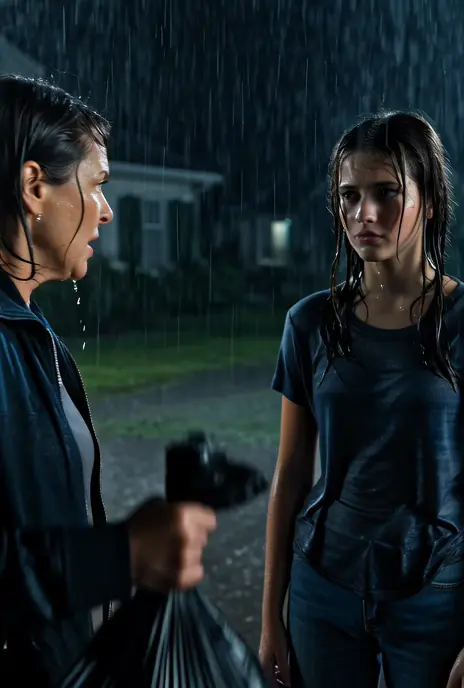
She looked up at me, her face a mask of that specific teenage contempt that feels like a physical punch. She didn’t cry. She didn’t beg. She just reached down, grabbed a handful of clothes, shoved them back into the crinkling blue plastic, and walked out the door.
Click.
I turned the deadbolt. I stood there, forehead pressed against the cold wood, waiting for her to scream. I waited for her to bang on the door. I waited for the neighbors to peek through their blinds. But there was nothing. Just the sound of the rain hitting the siding and the hum of the refrigerator.
For the first time in three years, the house was quiet.
The Slow Rot
People think you wake up one day and decide to be a monster. They think “kicking out a child” is a singular, villainous act. They don’t see the three years of slow-motion wreckage that leads up to it.
Maya wasn’t just a “difficult teen.” She was a hurricane. It started when she was eleven—a slow rot of small lies that escalated into a war of attrition. By fourteen, she was stealing from my purse, skipping school to hang out with twenty-year-olds in parking lots, and calling me things I wouldn’t say to a dog.
I was working two jobs, trying to keep a roof over our heads after her father checked out, and she was busy burning that roof down.
The night I kicked her out wasn’t even the worst fight we’d had. She’d come home four hours late, smelling of stale weed and that heavy, metallic scent of a basement party. When I asked where she’d been, she told me to “shut the hell up” and tried to push past me.
Something just snapped. Not like glass shattering—more like a bridge finally giving way under too much weight. I went to her room, grabbed the first bag I could find, and started shoveling her life into it.
“You want to live like an adult?” I had screamed. “Go be one. But you’re not doing it here.”
The Silence of the Aftermath
The first week was the weirdest. My neighbors, the ones who usually pretend not to hear the screaming through the walls, started looking at me differently. They noticed the lack of Maya. They noticed the way I didn’t look like I was on the verge of a stroke anymore.
I called her father, Mike. He lives three states away and thinks his job ends at the child support check.
“She’s out, Mike,” I told him. “I’m done.”
“You did what?” He sounded annoyed, like I was interrupting a game. “Elena, she’s fourteen. You can’t just put her on the street.”
“Then come get her,” I said. “She’s somewhere between here and the park. Have at it.”
He didn’t come. He never does.
Maya ended up at a friend’s house. Then another. Then, eventually, with a “family friend” who thinks I’m the devil incarnate. I didn’t reach out. I didn’t send a “thinking of you” text. I packed the rest of her stuff into three cardboard boxes, taped them shut until the seams groaned, and sent them in an Uber.
No note. No “I love you” card. Just the physical removal of her presence.
The Ghost in the Hallway
A month in, the “freedom” started to feel like a haunting.
I’d walk past her bedroom door and it would be closed—because I had closed it. I hadn’t cleaned it. I couldn’t bring myself to. The smell of her was still in there—cheap vanilla body spray and dirty laundry. Sometimes I’d sit on the floor in the hallway and just stare at the door handle, waiting for it to turn. Not because I wanted to hug her. I just wanted to see if I’d still feel that visceral, bone-deep fear of what she was going to say next.
Social services eventually knocked. A woman in a cheap blazer with a lanyard that said “Protecting the Future.” She asked me a lot of questions. I gave her a lot of blunt answers.
“Do you realize how this looks, Ms. Harrison?” she asked, her pen hovering over a clipboard.
“I don’t care how it looks,” I said. “I care about being able to sleep without locking my bedroom door from the inside.”
She didn’t have a follow-up for that.
Six Months Later
It’s been half a year. I see her occasionally on social media. She looks older. More makeup. She’s at concerts, sitting on the hoods of cars with boys who look like they’ve never held a job.
People want the “redemption arc.” They want me to say I cry every night and that I’m desperate for her to come home. They want the story to end with us hugging in the rain while acoustic guitar music plays.
But that’s not reality.
The reality is that my blood pressure is down. I’ve started painting again. I can walk through my own living room without bracing for an insult. I’ve reclaimed my life from a fourteen-year-old who was determined to ruin it.
Does it hurt? Sure. It hurts like a phantom limb. You know it’s gone, and you know you’re better off without the infection, but you still feel the itch where the hand used to be. I miss the little girl she was, but that girl died a long time ago. The person I kicked out was someone else entirely.
Last night, my phone buzzed at 2:00 AM.
Mom?
That was it. One word. No apology. No “I miss you.” Just a hook, dangling in the dark.
I looked at the screen for a long time. The blue light illuminated the kitchen. I thought about the IKEA bag. I thought about the smell of the basement party. I thought about the way she looked at me like I was garbage.
I didn’t reply. I put the phone face down on the counter, went back to bed, and slept through the night.
The house is quiet. And for now, that’s all I ever wanted.